


If 90’s one-hit-wonder The New Radicals taught us anything, it’s that we only get what we give. When it comes to data centers, though, most of the conversation revolves around taking. There never seems to be enough resources, capital, or capacity.
But studies have shown significant potential for integrating new load if flexibility measures are taken, and speed-to-power is a critical component of every developer’s calculus. So what if large-load customers could leverage renewable energy technology to become flexible assets and better accommodate grid conditions? Could data centers become “power plants,” in a sense?
That’s exactly what Calibrant Energy is going for in its deal with Iron Mountain Data Centers. Earlier this year, the energy solutions company signed a definitive agreement to build, own, and operate a 23 megawatt-hour (MWh) on-site battery energy storage system (BESS) at Iron Mountain’s New Jersey data center. When paired with the facility’s state-of-the-art solar array and some slick software, the 30-megawatt (MW) capacity campus becomes a unique tool and a potential blueprint for future applications.
The Future of Data Centers?
Located in Edison, NJ, NJE-1 is one of the largest and most resilient data centers in the Northeast, according to Iron Mountain. Located 30 miles from New York City, NY, and 66 miles from Philadelphia, PA, the 830,000-square-foot facility on a secure 43-acre campus provides “unmatched reliability, security, and connectivity for businesses in the Greater New York region and beyond.”
Built on a foundation of massive scale and high-performance specs, NJE-1 offers modular data center solutions for rapid deployment and flexible scaling, with multiple infrastructure configurations and systems that can be concurrently maintained. The center is billed as a connectivity hub, featuring a carrier-neutral ecosystem with 22plus carriers, major cloud on-ramps, and direct access to DE-CIX and IX-Reach. The campus is powered by Public Service Electric and Gas Company (PSE&G), New Jersey’s largest electric and natural gas utility.
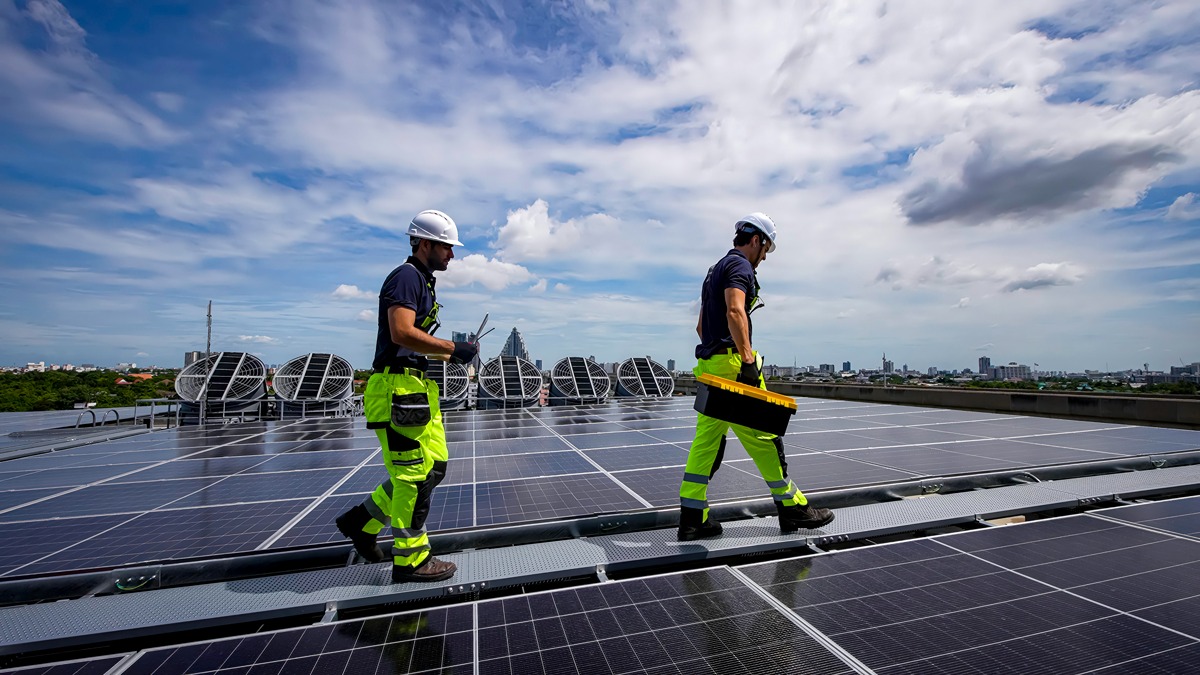
The 23 MWh BESS project with Calibrant Energy adds a new layer of grid-scale flexibility. The project integrates large-scale storage with the facility’s existing 7.2 MW rooftop solar installation, an 18,000-panel behemoth that currently holds the title of the largest photovoltaic (PV) installation at any North American data center. The result is a resilient energy ecosystem that supports Iron Mountain’s 24/7 carbon-free energy commitment with 100% renewable energy matching.
“This is what the future of powering large loads looks like,” ventured Phil Martin, CEO of Calibrant Energy. “Customers can grow and control costs while strengthening the grid, proving that large power users are part of the energy solution rather than a burden.”
Chris Pennington, senior director of energy and sustainability at Iron Mountain, identified battery storage as a critical component in his company’s broader strategy to support the local energy ecosystem.
“Flexible, on-site assets like this improve the economic and operational efficiency of the local utility grid, in addition to supporting increased reliability for all electric consumers,” he noted. “This project demonstrates how the data center industry can bring solutions to emerging grid challenges.”
A Dynamic Grid Asset
By using advanced real-time controls, the NJE-1 facility transforms its energy load into a dynamic asset that stabilizes the regional PSE&G grid during peak demand. This novel concept maintains uptime for Iron Mountain’s customers while eliminating the need for new, carbon-intensive power infrastructure in the local community, enabling data center clients to get online faster with reduced climate impact.
As electricity demand grows, especially from digital infrastructure, there is a need for a smarter model to power large loads such as data centers, Calibrant Energy’s chief commercial officer, Matt Barnes, told Factor This.
“This project demonstrates how distributed energy storage and advanced controls can help data centers scale responsibly while strengthening grid reliability and reducing costs in the process,” he explained.
“When you unlock capacity on existing infrastructure, instead of just building costly new carbon-intensive generation resources and transmission infrastructure, that’s good for customers and for communities,” Barnes continued.
“Looking ahead, the opportunity is significant, but it requires collaboration among developers, utilities, and regulators to prioritize more efficient utilization of existing grid assets alongside building new infrastructure to ensure we have the available power and resources to meet growing demand.”