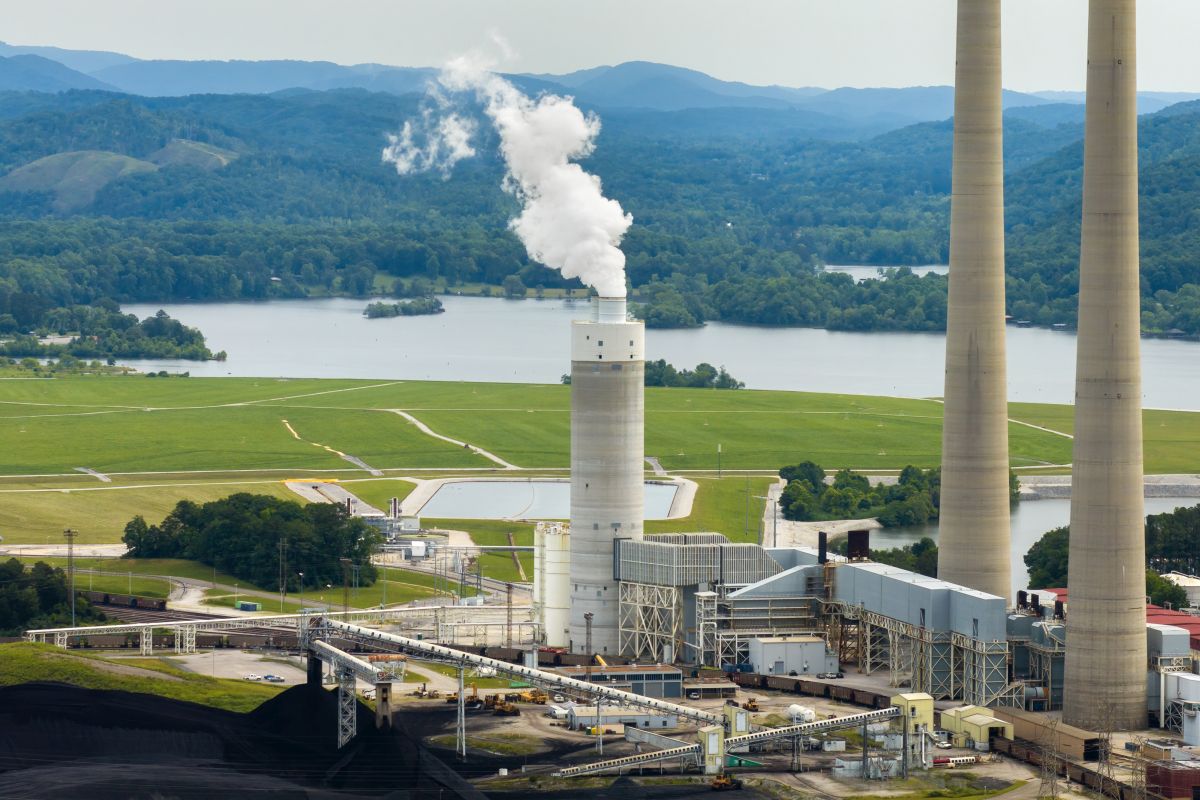



Since its launch in 2020, Certrec’s Fatigue Rule Management System has helped nuclear operators comply with NRC fatigue management requirements under 10 CFR Part 26. Recently FRMS has expanded its capabilities even further, providing workforce compliance solutions designed to automate staffing processes, improve operational performance, and support adherence to regulatory requirements. Together, these capabilities give nuclear facilities a single system for staffing decisions that used to require several separate tools.
The expanded platform integrates scheduling, compliance, and workforce safety functions to enhance decision-making when selecting staff. New capabilities include: Multi-Channel Shift Callout, Fatigue Assessments, Timekeeping, Shift Qualifications, and Passive Dosimetry.
1. Multi-Channel Shift Callout
Filling an open shift on short notice is one of the more time-consuming tasks a supervisor faces, especially when it involves working through a contact list by phone. FRMS Multi-Channel Shift Callout replaces that process with an automated system that notifies eligible personnel at once and tracks responses in real time.
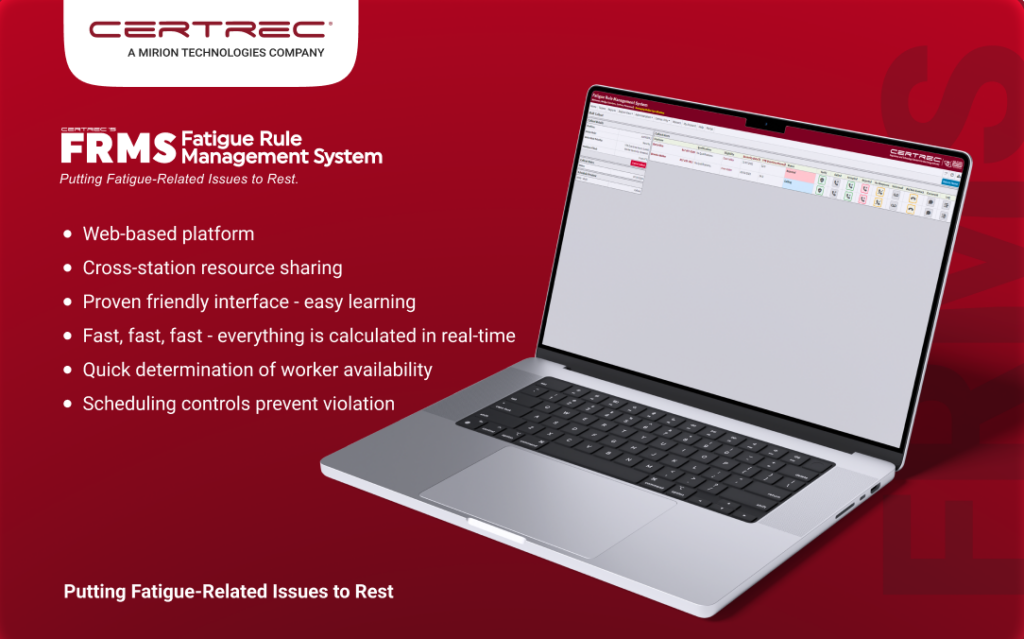
The module does more than speed up the process. It applies NRC fatigue rules, union seniority and overtime agreements, and training requirements before presenting staffing options, so supervisors aren’t left to verify eligibility manually. Every callout, whether accepted, declined, or unanswered, is logged automatically, giving facilities a clear record for reporting and accountability. The result is faster shift coverage with fewer administrative steps and less risk of assigning someone who shouldn’t be on the schedule.
2. Fatigue Assessment Capabilities
Fatigue assessments remain central to any nuclear fatigue management program, and FRMS continues to build on this foundation by developing tools designed specifically to meet the demands of NRC compliance. Rather than relying on manual documentation, supervisors and fitness-for-duty personnel can conduct assessments through a structured, automated workflow that applies established fatigue criteria consistently across the organization.
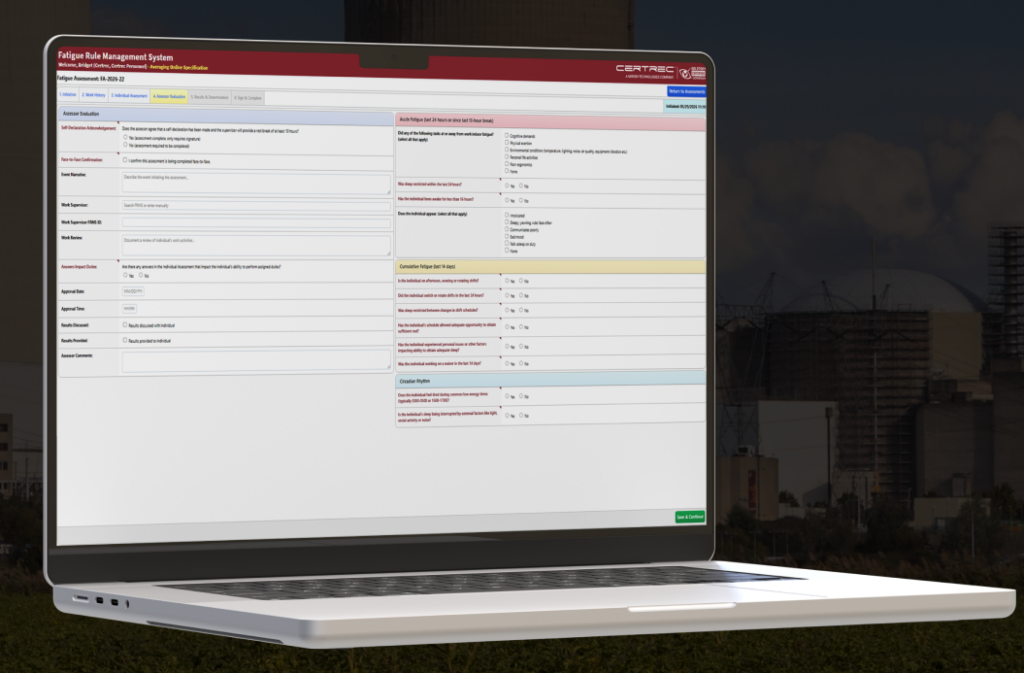
What makes this capability particularly useful is its connection to real-time scheduling data. Fatigue status doesn’t exist in isolation. FRMS evaluates fatigue factors for acute, cumulative and circadian rhythm to provide an automated determination of fatigue. All assessment records are stored in a centralized, structured repository, which simplifies retrieval during internal reviews and regulatory audits.
3. Shift Qualifications
Nuclear facilities manage a wide range of certifications and training requirements. When qualification data is separate from scheduling and fatigue systems, verifying eligibility becomes an additional manual step for every assignment.
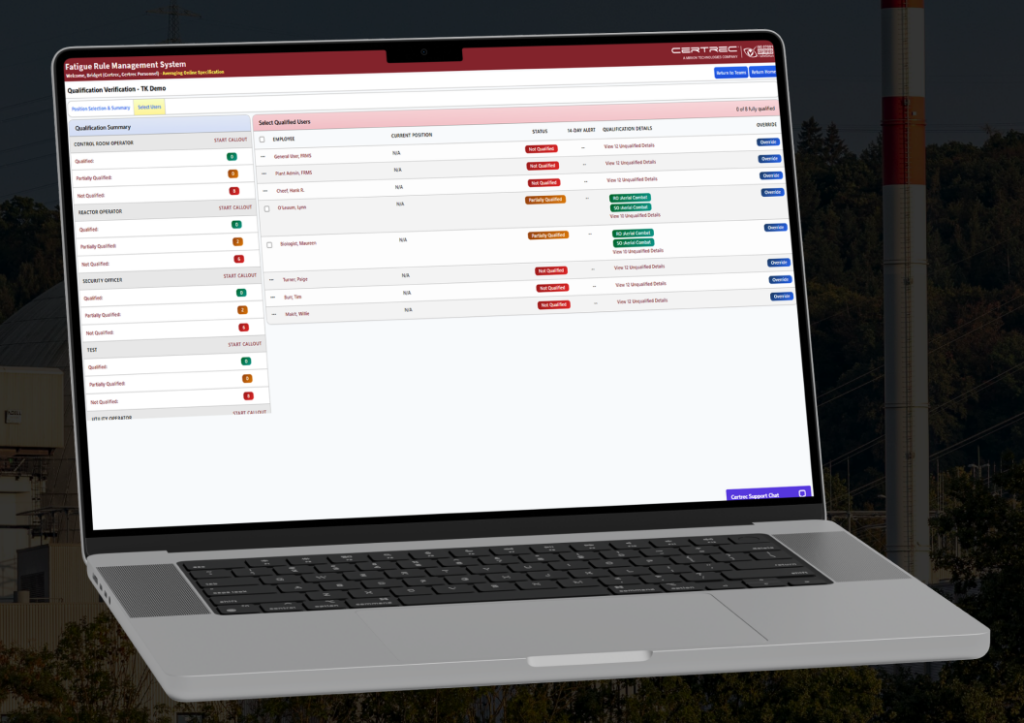
FRMS Shift Qualifications addresses this by integrating qualification tracking directly into the scheduling process. The system checks qualification requirements and fatigue status together, so only personnel who meet both criteria are eligible for safety-critical assignments. The module also integrates with Learning Management Systems, keeping qualification records up to date without requiring separate data entry. For facilities managing certifications across multiple departments, this creates a single, reliable source of qualification data tied directly to scheduling decisions.
4. Timekeeping
Recording work hours for payroll and recording them for fatigue compliance have traditionally been two separate tasks, often requiring the same information to be entered twice. That duplication adds administrative work and increases the chance of a transcription error affecting compliance records.
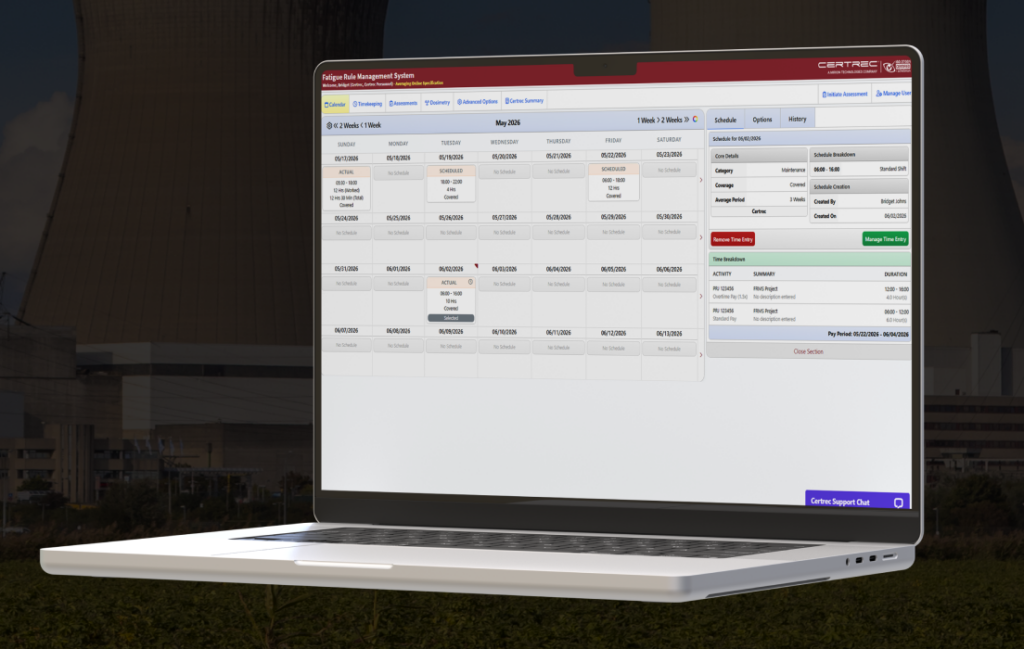
FRMS Timekeeping consolidates these processes into one workflow. Employees enter their hours once, and that data supports both timekeeping and compliance with fatigue rules. Because work-hour records feed directly into fatigue calculations, supervisors have immediate visibility into fatigue status without waiting for updates from a separate system. Automated checks also flag potential work-hour issues before a shift is assigned, allowing facilities to address problems proactively rather than after the fact. When it’s time to prepare for an audit or internal review, Timekeeping provides ready-made reports that reduce the need to compile information manually.
5. Passive Dosimetry
Radiation dose tracking is a critical part of workforce safety in nuclear facilities, but it has traditionally been managed apart from scheduling. That separation can slow down staffing decisions, particularly when a supervisor needs to fill an urgent assignment while confirming dose eligibility.
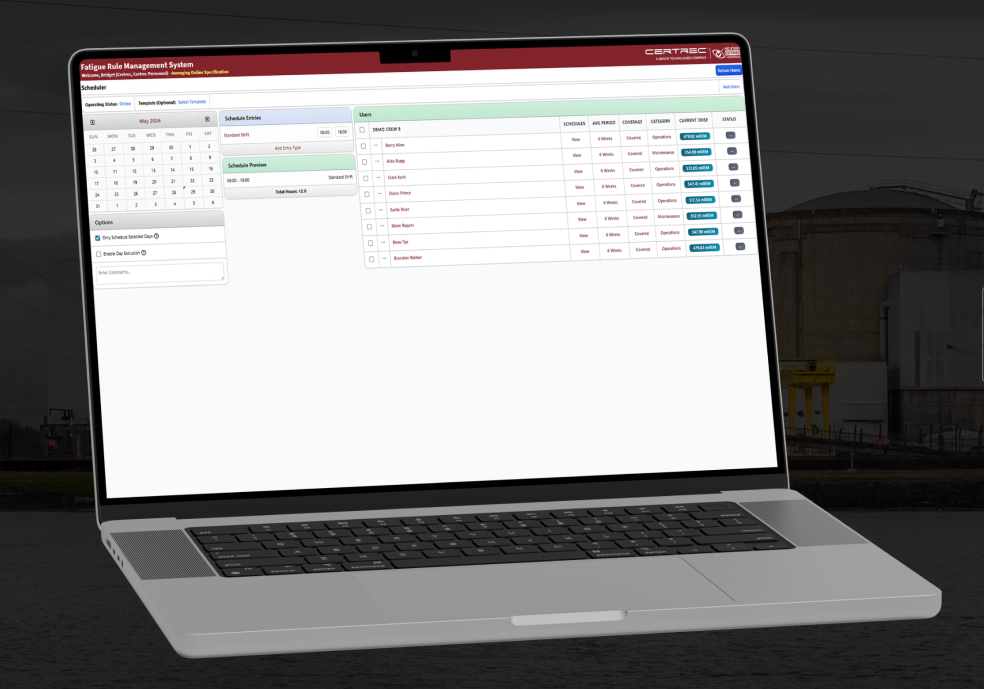
FRMS Passive Dosimetry brings radiation dose data into the same workflow used for scheduling. Supervisors can view a worker’s accumulated occupational dose, along with both federal limits and site-specific administrative controls, without switching to a separate system. Visual indicators flag personnel approaching or exceeding dose thresholds, and built-in search tools allow supervisors to quickly identify eligible workers or crews for a given day. This is especially valuable during emergent work, when finding the right person quickly matters as much as finding a qualified one.
Integrated Workforce Compliance Platform
A single staffing decision at a nuclear facility can require checking fatigue status, work hours, qualifications, and radiation dose all at once. Handling these functions across separate systems takes time and introduces room for error. FRMS removes that friction by centralizing the information supervisors need on a single platform built specifically for nuclear operations.
This integration also benefits the organization beyond day-to-day scheduling. Operations, training, supervisors, and radiation protection teams all depend on accurate, current workforce data. When that data lives in one system rather than several disconnected ones, departments spend less time reconciling records and more time focused on their core responsibilities. Standardized documentation and automated workflows also make compliance reporting more straightforward, whether preparing for an internal review or responding to a regulatory audit.
Conclusion
The expansion of FRMS reflects a broader shift in how nuclear facilities are approaching workforce compliance. Meeting today’s operational and regulatory demands requires more than isolated tools for fatigue tracking or scheduling. It requires a connected system that gives supervisors the full picture before they make a decision. Fatigue compliance remains at the foundation of the platform. Still, the addition of shift callout management, fatigue assessments, qualification tracking, timekeeping, and passive dosimetry turns FRMS into a comprehensive workforce compliance solution purpose-built for the nuclear industry.
FAQs
1. What are the key drivers of the U.S. electricity market in 2026?
2. How is renewable energy expected to impact the U.S. electricity market in 2026?
3. Will electricity demand increase in the U.S. by 2026?
4. What challenges could affect the U.S. electricity market in 2026?
5. How are utilities preparing for the future electricity market?
Disclaimer: Any opinions expressed in this blog do not necessarily reflect the opinions of Certrec. This content is meant for informational purposes only.